Transforming a recipe into a true feast often relies on the accuracy of measurements. Converting grams to ounces or milliliters to cups can be tricky for amateur cooks as well as seasoned chefs. A conversion error can easily upset the balance of a dish, making a sauce too runny or a dough too dense.
To avoid these pitfalls, make sure to master some basic cooking conversions. Knowing the equivalents between different units of measurement allows you to faithfully follow recipes, whether they come from foreign books or are passed down by friends across the Atlantic.
The Basics of Measurement Units in Cooking
To navigate the complex world of cooking conversions, it is essential to master the main units of measurement. In cooking, ingredients are often measured in liters, deciliters, centiliters, and milliliters. Understanding these units and their equivalents helps avoid costly mistakes in recipe preparation.
Here are some essential conversions:
- 1 liter = 100 centiliters = 1000 milliliters
- 1 centiliter = 10 milliliters
- 1 deciliter of water = 100 grams
- 1 deciliter of flour = 50 grams
- 1 deciliter of butter = 90 grams
- 1 deciliter of granulated sugar = 85 grams
To measure smaller quantities, tablespoons and teaspoons are commonly used. In France, a tablespoon equals 15 milliliters, while in the United States, it corresponds to 20 milliliters. A teaspoon, on the other hand, equals 5 milliliters on both sides of the Atlantic.
In practice, converting volumes can quickly become a headache. Take, for example, the conversion of 1/4 liter to centiliters: you just need to know that one liter equals 100 centiliters, so 1/4 liter corresponds to 25 centiliters. This quick and easy method is detailed on the page ‘Conversion of 1/4 liter to cl: quick and easy method – dNews’.
Solid measurement units such as kilograms, grams, and ounces are equally important. One ounce equals 28.35 grams. These measurements apply to various ingredients like flour, butter, or granulated sugar, with specific equivalents for each type of ingredient.
To avoid approximations, use precision tools such as kitchen scales and measuring cups. These instruments facilitate conversion and ensure the success of your recipes. 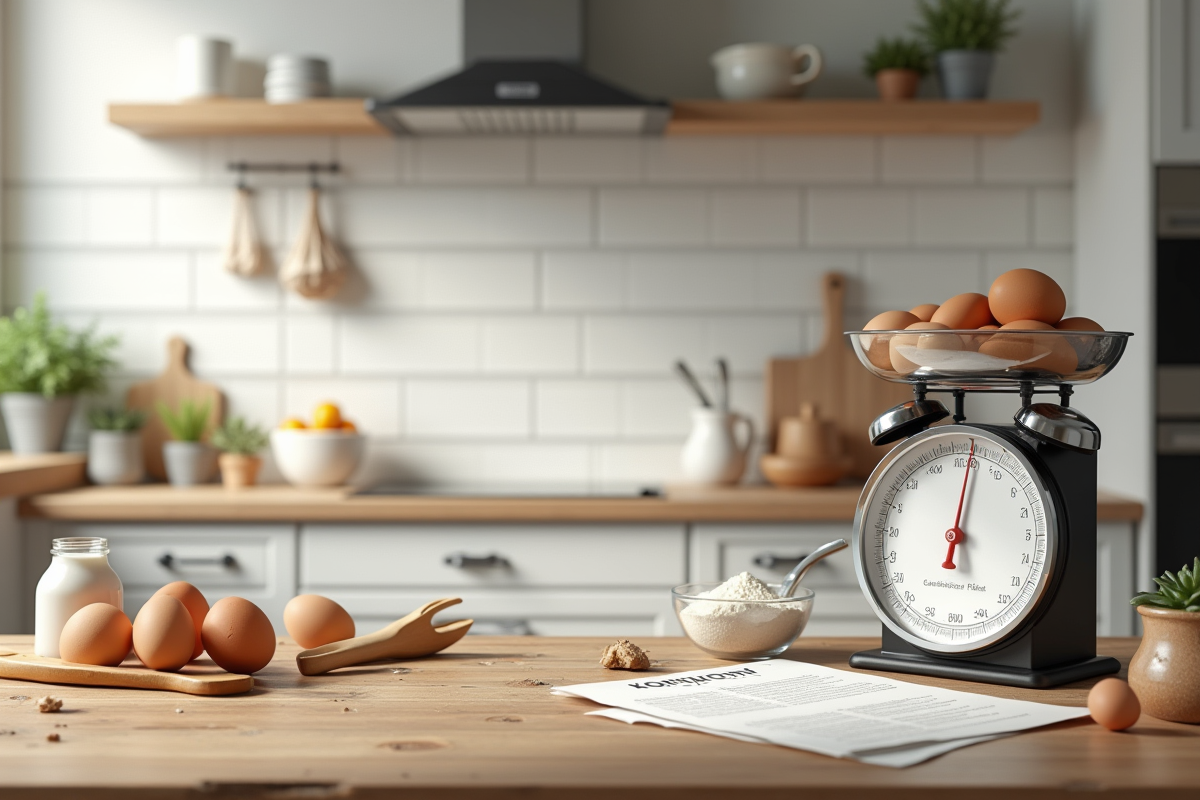
Techniques and Tools for Accurate Conversions
To ensure accurate conversions in cooking, using appropriate tools is essential. Measuring cups and kitchen scales allow for precise measurement of ingredients, thus avoiding approximations that could alter your recipes.
Essential Measuring Tools
- Measuring cups: Used to measure liquids, they are often graduated in milliliters and centiliters. Some models also include measurements for flour, sugar, and butter.
- Kitchen scales: Allow for measuring solid and liquid ingredients in grams and kilograms. Choose a scale with a precision of 1 gram for optimal results.
- Measuring spoons: Comprising tablespoons and teaspoons, they are ideal for small quantities. A tablespoon equals 15 milliliters in France and 20 milliliters in the United States.
Mobile Apps and Online Tools
Mobile apps and online conversion tools also make measurement conversions easier:
- Mobile apps: Download apps dedicated to culinary conversions for quick and accurate conversions. They allow you to convert volumes, weights, and even temperatures.
- Online tools: Use specialized websites to obtain comprehensive conversion charts, especially for common ingredients like water, flour, butter, and granulated sugar.
Recommended Resources
Books such as The Official Companion Bible and My Robot & Me No. 32 – Light Cooking offer practical guides and tips for accurate conversions. These books can be purchased on platforms like Amazon and Rakuten. They are valuable references for any amateur or professional looking to master culinary conversions.