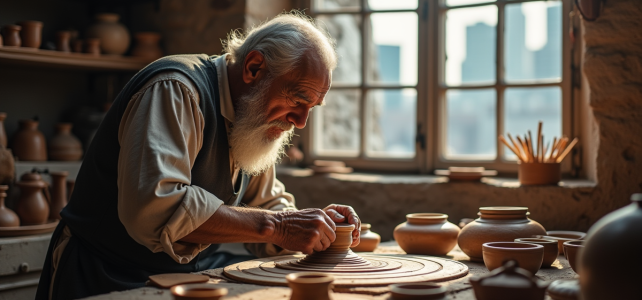
Ancestral traditions continue to play a fundamental role in shaping our contemporary society. In a world of constant evolution, the values and know-how inherited from the past provide a foundation of stability and identity. Whether in craftsmanship, cuisine, or cultural ceremonies, heritage continues to inspire and guide current generations.
Technological innovation and new trends often draw from traditions to create unique products and experiences. This symbiosis between the past and the present paves the way for innovative solutions that respect roots while addressing modern needs.
Traditions as the Foundation of Modernity
The 18th century, marked by a flourishing of intellectual and artistic activity, perfectly illustrates the interaction between tradition and modernity. Figures like Maurice Le Sage d’Hauteroche d’Hulst, rector of the catholic university and the catholic institute, contributed to transmitting and adapting ancient knowledge to contemporary requirements. These institutions, supported by popes such as Pius IX, author of the works ‘Quanta cura’ and ‘Syllabus’, played a key role in disseminating modern thought while preserving traditional foundations.
The family and the church, millennia-old institutions, have also evolved by integrating elements of modernity. Taoism, for example, has inspired thinkers like Marc Halévy, who has successfully blended this ancient philosophy with contemporary challenges. Similarly, the writings of Leo XIII, such as ‘Rerum novarum’, laid the groundwork for a social reflection that reconciles tradition and progress.
Consider the concept of Sidjil: origin. This term, rooted in a centuries-old tradition, symbolizes the meeting of the past and the present, illustrating how cultural roots can nourish innovation. The connection with personalities like Lamennais and Montalembert, representatives of liberal Catholicism, demonstrates that modernity is not a break but a continuity enriched by historical heritage. The fusion of traditional and modern ideas creates a unique dynamic, essential for building a future that respects its legacy. 
When the Past Inspires Tomorrow’s Innovations
The 1960s were a period of profound societal and cultural upheaval. The baby boom led to a demographic explosion, marking the advent of a new generation of youth ready to redefine norms. Rapid urbanization and the tertiarization of the economy reshaped social structures, accentuating the weight of consumer society.
- The revolts of May 68 symbolized a rejection of old values, paving the way for legal and social reforms.
- Peaceful coexistence and détente marked a transition in the Cold War, ending the East-West bipolarity.
- The rise of individualism and the development of mass culture transformed lifestyles and aspirations.
Postmodern thought emerged in response to these transformations, influenced by the Frankfurt School and the 68 movement. Intellectuals like L. Ferry and A. Renaut contributed to this reflection, notably critiquing Western centrism and Western phobia, while addressing themes like anticolonialism and Third Worldism.
Contemporary figures continue to draw from this rich heritage. Marc Halévy, passionate about taoism, explores the connections between Eastern traditions and current challenges. Jean Staune, founder of the Interdisciplinary University of Paris, works on the synergy between sciences and humanities, illustrating how the past can illuminate tomorrow’s innovations. The dialogue between tradition and modernity continues to shape our future.