
Your Bosch trimmer line keeps breaking, or the spool spins empty without cutting a blade of grass. Before suspecting a motor failure, the problem often comes from a poorly installed or incompatible line for the model. Knowing how to replace this consumable correctly extends the lifespan of the device and avoids interruptions during mowing.
Diameter and reference of the nylon line: what the Bosch manual requires
Have you ever bought a trimmer line randomly from a gardening aisle? The diameter listed on the packaging is not enough. Each Bosch model accepts a specific maximum diameter, indicated in the user manual.
A line that is too thick may get stuck in the eyelets of the cutting head. The motor has to work harder, and the spool may jam. Conversely, a line that is too thin breaks quickly in dense grass and forces you to reload constantly.
The Bosch ART and EasyGrassCut ranges do not use the same consumables. The ART 26 Combitrim, for example, can accept high-performance pre-cut lines of 26 cm with a diameter of 2.4 mm (Bosch reference F016800181). If you own an EasyGrassCut, this refill will not fit: check the exact reference before ordering.
To change the Bosch trimmer line without any unpleasant surprises, always start with the model number engraved on the device, then cross-reference it with the compatible consumables listed by the manufacturer.
Spool to wind or pre-cut line: identify your Bosch cutting head
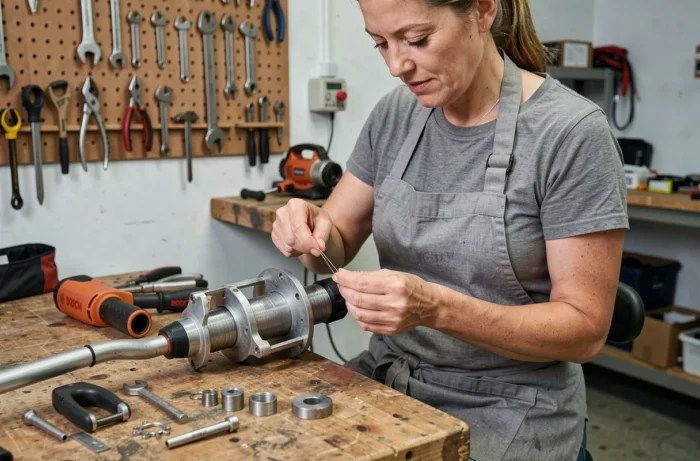
Not all Bosch trimmers are reloaded in the same way. The method depends on the type of head mounted on your device. Confusing the two means forcing incompatible parts.
Classic spool head
On this system, a continuous line is wound around a spool located under the cover. When the line shortens, you tap the head on the ground to release a few centimeters. This is the so-called “Tap and Go” or “Autocut” mechanism, depending on the Bosch series.
The line must be wound in the direction indicated by the arrow engraved on the spool. A reverse winding will block the unwinding and break the line as soon as it starts. Wind evenly, without crossing the coils, while maintaining slight tension with your fingers.
Pre-cut line head
Some models, like the ART 26 Combitrim, accept rigid line segments, inserted one by one into eyelets. No spool to wind: you slide the line until it hits the stop, and it is held by friction.
This system simplifies reloading but requires you to buy lines of precise length and diameter. A line cut by hand from a generic roll may not hold if its diameter differs by a few tenths of a millimeter.
Procedure for replacing the line on a Bosch spool
Before any handling, unplug the device or remove the battery. An accidental start with fingers near the cutting head can cause injuries.
- Turn the trimmer upside down and press the locking tabs of the spool cover to remove it. On most Bosch models, two side clips detach by pressing simultaneously.
- Remove the empty spool, clean the inside of the cover (grass, dirt, melted nylon residues). A dirty housing prevents the spool from turning freely.
- Insert the end of the new line into the locking hole of the spool, then wind in the direction of the arrow while keeping the coils neatly side by side.
- Leave enough length for the line to come out through the eyelet of the cover. Replace the spool, thread the line through the eyelet, then snap the cover back until it clicks into place.
Gently pull the line to check that it unwinds without blockage. If the spool resists, open it again and check that the coils do not overlap.
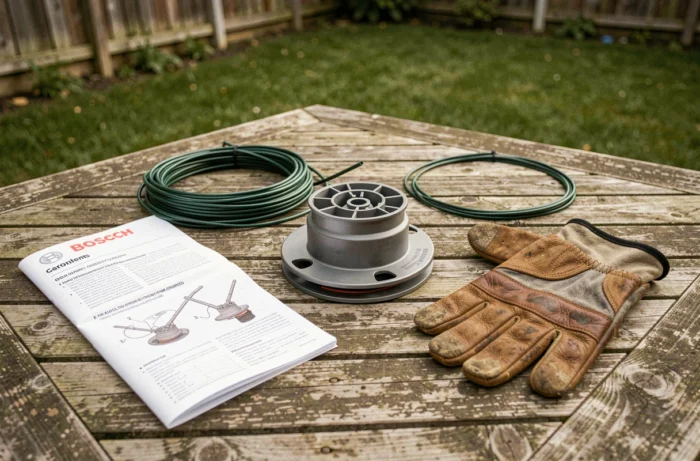
Storing nylon line: a detail that prevents repeated breakage
Why does a new line sometimes break within the first few minutes? The problem is not always mechanical. A nylon line stored too long in a warm or very dry shed becomes brittle. Nylon loses its flexibility by dehydrating.
To maintain its properties, keep the spool of line in a cool place, away from direct sunlight. Some users place it in an airtight bag with a slightly damp cloth. This simple precaution significantly extends the lifespan of the consumable.
If your line consistently breaks while the diameter is correct and the spool is properly mounted, try using a recent roll. A line bought on sale and left for two years in an overheated garage has probably become unusable.
Round line, serrated line, or twisted line: adapt the section to the task
The type of line section changes its cutting behavior. A round line is suitable for regular lawn maintenance. For tall grasses or tough weeds, a square or twisted line cuts more effectively due to its edges.
Check that your Bosch head accepts the chosen profile. A stiffer serrated line sometimes requires a slightly smaller diameter to fit through the eyelets without forcing. The right compromise lies between cutting efficiency and mechanical compatibility with the model.
One last often-overlooked point: the length of line extending from the head influences the cutting width as well as the load on the motor. Adhere to the length recommended by Bosch for your model. A line that is too long whips the air, slows rotation, and unnecessarily strains the motor or battery.
Replacing the line remains the most frequent maintenance operation on a trimmer. With the right diameter, the correct winding method, and properly stored line, most breakage or jamming issues disappear without needing to replace any mechanical parts.