
Organizing a wedding in Switzerland requires a mastery of the cantonal administrative framework before any aesthetic considerations. The preparatory procedure for marriage, mandatory in every civil registry office, determines the actual timeline of the event, and this is where most couples waste time.
Civil marriage preparatory procedure in Switzerland: deadlines and required documents
The competent civil registry office sets the required documents, which vary according to the nationality of the spouses. For foreign nationals, documents must be provided in original, translated into a Swiss national language, and sometimes authenticated by a Swiss diplomatic representation. This process can take several months.
In Winterthur, for example, the procedure must be initiated at least three months and no later than three weeks before the desired date. Once a favorable decision is made, the ceremony must take place within three months. These deadlines are not uniform: each canton and municipality applies its own practical rules.
We recommend contacting the civil registry office of the ceremony location directly as soon as the decision to marry is made, even before booking a reception venue. A wedding planner based in Switzerland can check this administrative timeline for the couple, but they do not replace the office. Specialized wedding planning providers, like those found through the Mariage De Rêve website, are familiar with these cantonal specifics and guide couples to the right administrative contacts.
For international couples, the complexity increases further. The recognition of a marriage contracted abroad requires registration in the Swiss civil registry, with a separate file. Anticipating this step avoids legal blockages after the celebration.
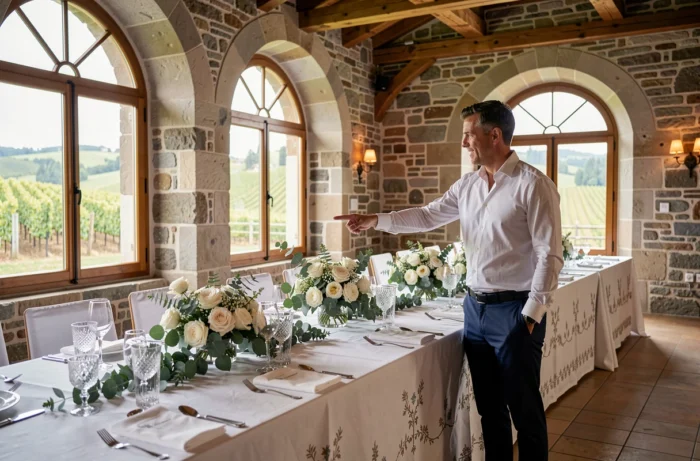
Noise constraints and reception venue: an underestimated operational risk
Noise restrictions vary by canton and municipality, and they also apply to private parties. A Valais castle will not have the same permitted hours as a Geneva hotel in an urban area. Some venues impose sound limiters and strict end times for outdoor music.
Ask the venue, before signing the contract, about the decibel limits, permitted hours, and mandatory equipment. A professional music provider in Switzerland should be able to adapt their set to these technical constraints. If the venue does not provide this information in writing, it is a warning sign.
We regularly observe couples who book a DJ or live band without checking these points. The result: an evening cut off at 10 PM instead of midnight, or a municipal fine. The organizing agency or planner must incorporate this verification into their standard service.
Selecting a wedding planner in Switzerland: technical criteria rather than portfolios
The Swiss wedding planning market lacks formal regulation. Anyone can declare themselves a wedding organizer. Here are the concrete criteria that separate a reliable professional from an amateur:
- Knowledge of cantonal administrative procedures, not just decoration or day-of coordination. A planner who does not mention the preparatory procedure during the first meeting lacks experience in the Swiss field.
- A network of verified providers in the targeted canton (caterer, photographer, florist, DJ) with standard contracts including cancellation clauses compliant with Swiss contract law.
- The ability to manage multilingual logistics. In Romandy, an event may involve German-speaking, French-speaking, and Italian-speaking guests, which affects the secular ceremony, signage, and service.
- Professional liability insurance covering the event, a point that few couples think to check.
A good planner anticipates local regulatory constraints rather than simply offering a custom mood board.

Marriage regime and expatriation: what the couple must settle before the ceremony
For Franco-Swiss couples or expatriates living in Switzerland, the choice of marriage regime has direct property consequences. The Swiss legal regime (participation in acquisitions) differs from the French regime of community property, and the place of residence at the time of marriage determines the applicable law by default.
A marriage contract drafted before the ceremony allows for the explicit choice of the applicable regime. This process requires a notary and, in some cases, bilateral legal consultation. Couples who move to Switzerland after a marriage celebrated in France must check whether their regime is automatically recognized or if it requires adaptation.
This legal aspect is rarely addressed by wedding planning agencies. We recommend that affected couples consult a specialist in international matrimonial law before finalizing logistical preparations.
Micro-wedding in Switzerland: reduced format, intact complexity
The micro-wedding format (limited guest list) is gaining traction in Switzerland, but a smaller list does not mean a proportionally lower budget. Fixed costs (venue, photographer, officiant, flowers) remain the same regardless of the group size. The cost per guest mechanically increases.
The real advantage of a micro-wedding lies in the flexibility of accessible venues. A Michelin-starred restaurant, a tasting room in Lavaux, or a charming small hotel in Geneva become feasible when the group does not exceed twenty people. Negotiation with these establishments differs: they often offer privatization packages rather than standard wedding packages.
The administrative framework remains strictly the same. The preparatory procedure, documents, deadlines: nothing changes because the celebration is intimate. Every wedding in Switzerland goes through the civil registry, regardless of its size.