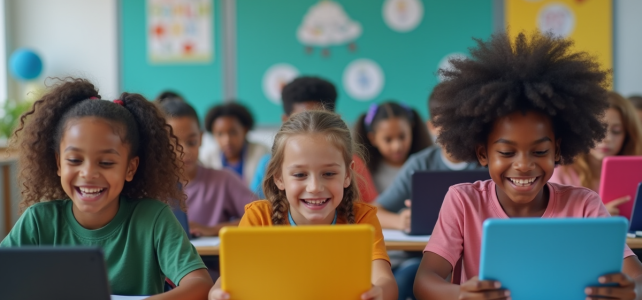
Today’s middle school students have a range of digital tools that transform their learning experience. Tablets are gradually replacing textbooks, allowing instant access to a multitude of educational resources. Interactive applications make subjects more engaging and facilitate the understanding of complex concepts.
In addition to tablets, online course platforms and classroom management software are revolutionizing communication between students and teachers. Assignments can be submitted online, grades checked in real-time, and collaborative projects completed, even remotely. These innovations promise to make education more accessible and engaging for everyone.
The advantages of digital tools for middle school students
The integration of digital tools into the daily lives of middle school students offers unprecedented opportunities to enrich their education. Among the obvious benefits, educational continuity in case of absence is ensured through online platforms. Applications like Oze on enc.hauts-de-seine.fr allow students from Hauts-de-Seine to follow their classes and submit their assignments, even remotely.
Accessibility and inclusion
Digital technology plays a fundamental role in inclusive education. Systems like ULIS (Localized Units for School Inclusion) benefit from information and communication technologies for education (TICE) to adapt educational content to the specific needs of students with disabilities. These technologies enable personalized learning, thus facilitating access to education for all.
Development of digital skills
The use of digital tools such as typing software or content creation applications also prepares students for the demands of the professional world. Early mastery of these tools, validated by certifications like Pix Edu, is now a major asset. The Ministry of Education places great importance on integrating these skills into school curricula.
- Digital resources: access to an unlimited library of knowledge.
- Artificial intelligence: personalization of learning paths.
- Digital strategy: preparation for the technological challenges of tomorrow.
The inclusion of these digital tools in school curricula transforms the way students interact with knowledge, thus preparing a generation better equipped for future challenges.
Essential digital tools for middle school students
Educational digital tools are becoming indispensable allies for middle school students. Among them, digital utilities offer a wide range of practical applications. For example, creating a class plan and managing the school timetable are simplified thanks to software specifically designed for these tasks.
- School-friendly fonts: help with learning writing and reading.
- Quizzes and MCQs: tools for ongoing student assessment.
- File converters: facilitate document format changes.
Interactive tools for interactive whiteboards (IWBs) or projectors enrich teaching methods. These devices allow for increased interactivity in the classroom, making lessons more dynamic and engaging. Teachers thus have greater flexibility to adapt educational content to their students’ needs.
Video platforms like YouTube without ads also provide valuable support. They allow teachers to share audiovisual resources without distractions, optimizing students’ attention spans.
The advent of artificial intelligence in education opens new perspectives. Applications equipped with sophisticated algorithms can personalize learning paths, offering tailored support to each student. These technologies, still in development, promise to radically transform teaching methods.
Responsible digital tools, often free and open-source, provide an accessible alternative for educational institutions. Their adoption promotes ethical and sustainable use of technology, aligned with the values of national education. These tools are integrated into programs like educational digital territories, aimed at reducing inequalities in access to digital resources.