
The year 2024 has produced fewer spectacular disruptions than structural shifts. On the hardware side, transparent screens and chips dedicated to embedded AI have moved beyond the prototype stage. On the regulatory side, the European Union has established legal frameworks that redefine what manufacturers and publishers can market. This dual movement, technical and normative, shapes the landscape in which the tech trends of 2024 find their real meaning.
AI Act and Cyber Resilience Act: the regulatory framework that conditions innovation in 2024
The European Union published two major texts in 2024, and their effects are already being felt across the entire technology sector.
The regulation (EU) 2024/1689, known as the AI Act, was published in the Official Journal of the European Union on July 12, 2024. Its implementation is gradual: the bans and the obligation for general knowledge in AI apply from February 2025, and the obligations concerning general-purpose AI models from August 2025. Any company that develops or deploys an AI system classified as “high-risk” must now document its datasets, potential biases, and human oversight mechanisms.
The text is no longer a theoretical framework but a tool for concrete application that you can follow through Sarkostique’s tech articles, which regularly cover these regulatory topics.
The second text, the Cyber Resilience Act (regulation (EU) 2024/2847, adopted on October 23, 2024), imposes horizontal cybersecurity requirements on all products containing digital elements. Connected objects, consumer software, industrial equipment: manufacturers will need to integrate security from the design stage, or they will no longer be able to market their products in the EU.
Generative artificial intelligence: beyond the hype, the technical limits
Generative AI has dominated the tech conversation in 2024. Language models have proliferated, and integrations into professional tools have increased as well. The available data does not yet allow for conclusions about the actual return on investment for most companies deploying them.
Advancements in language models have enabled concrete uses: simplifying interactions between customer service and clients, generating marketing content, assisting with coding.
However, several limitations persist:
- The reliability of responses remains an unresolved issue. Hallucinations (false information presented confidently) affect all models on the market, including the most recent ones.
- The energy cost of training and inferring from large models raises sustainability questions that few trend reports address frankly.
- The AI Act classifies certain uses of generative AI in the category of systems with enhanced obligations, which imposes transparency obligations on general-purpose model providers regarding training data.
The hype surrounding generative AI has also overshadowed other branches of artificial intelligence, particularly machine learning applied to health (MedTech) and industrial predictive maintenance, which are progressing with measurable results.
Post-quantum cryptography: the silent migration of 2024
In August 2024, NIST published its first post-quantum cryptography standards: FIPS 203, FIPS 204, and FIPS 205. These standards will have lasting consequences on all digital infrastructures.
These standards aim to prepare for the migration to algorithms resistant to future quantum computers. The threat is not immediate (no current quantum computer can break existing encryptions), but data encrypted today could be decrypted tomorrow if intercepted and stored until the necessary computing power becomes available.
This strategy, known as “harvest now, decrypt later,” justifies that the transition begins now. Companies handling sensitive data (health, finance, defense) are the first concerned. NIST’s standardization transforms a research topic into a technical obligation for encryption solution providers.

Hardware and connected objects: the concrete announcements from CES 2024
CES 2024 showcased several categories of products that illustrate the directions taken by the hardware industry.
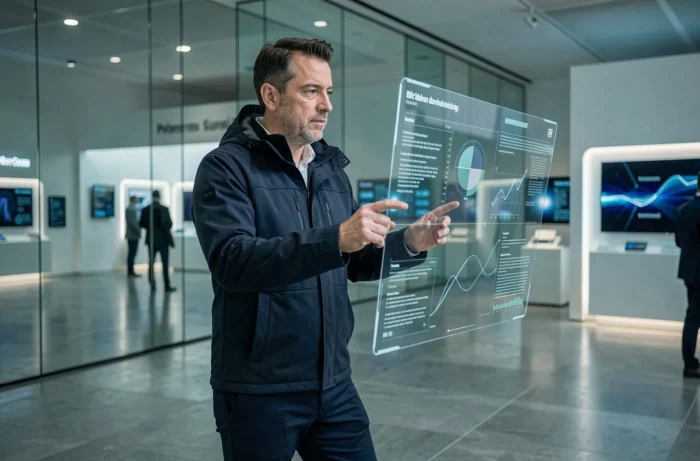
Transparent screens have reached a level of maturity. Samsung, LG, and other manufacturers presented panels usable in real contexts (store windows, partitions in living spaces) and no longer just as technological demonstrators.
Embedded AI in vehicles has been the subject of many announcements. The trend is no longer towards level 5 autonomous vehicles (fully human-free driving), but towards targeted assistance: monitoring driver attention, planning routes that integrate real-time traffic conditions, advanced voice interaction.
In the realm of domestic robotics, robot vacuums now integrate vision-based navigation systems and mapping capabilities that were considered high-end two years ago. Field feedback varies on the reliability of these systems in complex environments (low furniture, cables on the floor, pets).
What these announcements reveal
The common thread of CES 2024 is not a unique technology but the integration of AI into product categories that already existed. The innovation of 2024 lies less in disruption than in integration: making existing objects more autonomous, more adaptive, more contextual.
The tech trends of 2024 are better understood through the constraints that frame them than through the promises that accompany them. The AI Act and the Cyber Resilience Act redefine what is marketable. Post-quantum cryptography imposes a technical migration to be anticipated over several years. Hardware evolves through integration rather than disruption. Reading these signals together provides a more accurate picture of what 2024 has truly changed.